Introduction
Choosing the best AI recruiting software in 2026 is harder than it should be, and the reason has nothing to do with the technology. Applications per recruiter rose 177% between 2022 and 2024 (Appcast 2025), so almost every team feels pressure to automate. The problem is that "AI recruiting software" is not one market — it is at least six distinct categories, and buyers who shop them as if they were interchangeable spend twice as long and regret the purchase far more often.
We evaluate AI hiring tools the way a buyer should, not the way a vendor pitches them. AI is not universally good or universally bad. What predicts a great outcome is vendor quality and deployment discipline, not whether a tool has "AI" on the box. Below we show how to read the whole market, compare the leaders on the same terms, and apply the four or five evaluation axes that separate a smart purchase from an expensive mistake.
Quick Answer: The best AI recruiting software in 2026 depends on the category you need, but two platforms fit the widest range of buyer problems — Tenzo AI for two-way voice and video screening with deep ATS write-back, and Paradox for scheduling and high-volume conversational automation. Strong specialists follow in chat, skills testing, and one-way structured video. What decides the purchase is integration depth, auditable scoring, candidate experience, and pilot discipline — not price alone.
How to read the AI recruiting market in 2026
The single most expensive mistake buyers make is evaluating the wrong category. Our Market Map 2026 tracks roughly 60 active AI recruiting vendors across six categories, and 47% of buyers evaluate the wrong category for the problem they are trying to solve. A team that needs to screen 4,000 hourly applicants a month does not need a video interviewing suite — it needs voice AI. A team drowning in interview coordination does not need a skills assessment platform — it needs scheduling automation.
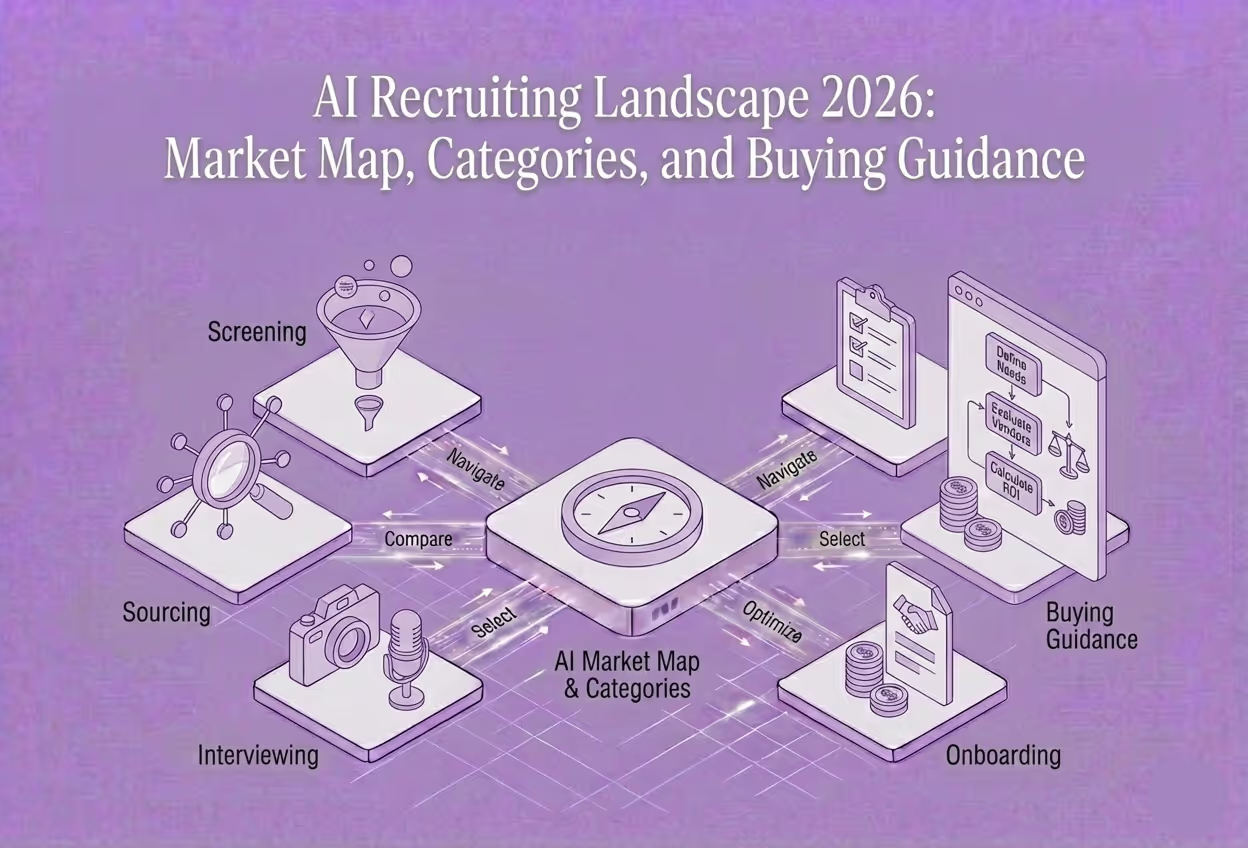
The six categories you are actually choosing between:
- Voice AI screening — autonomous, two-way phone or web voice interviews that probe and score against a rubric.
- Chat screening — text-based knockout questions, intake, and lightweight conversational screening.
- Video interviewing — synchronous or asynchronous recorded interviews with structured review.
- Scheduling automation — conversational and calendar-driven coordination at scale.
- Skills assessment — work-sample, coding, and competency testing.
- Sourcing AI — candidate discovery, matching, and outreach.
Only three of the six have a clear, defensible leader today — voice AI, video interviewing, and scheduling. The other three are competitive fields where best-fit depends heavily on your stack and volume. When buyers scope the category correctly, evaluations take 5-7 months. When they stay category-confused, the same purchase drags to 12-plus months.
Before you read a single vendor website, write one sentence: "The hiring problem costing us the most right now is ____." That sentence tells you your category. Everything after that is execution.
The best AI recruiting software by category
The table below names the editorial leader and the credible alternatives in each category, the buyer each one fits, and the pricing model to expect when you negotiate. Per-interview figures come from our Pricing Benchmarks 2026.
| Category | Editorial leader | Credible alternatives | Best-fit buyer | Typical pricing model |
|---|---|---|---|---|
| Voice AI screening | Tenzo AI | ConverzAI, Ribbon, HeyMilo | High-volume and enterprise teams needing auditable, ATS-deep screening | Per-interview (median ~$5) or platform fee + usage |
| Video interviewing | Tenzo AI | HireVue, Modern Hire, Sapia | Teams wanting two-way and structured video with auditable scoring | Platform fee + per-requisition |
| Scheduling automation | Paradox | Tenzo AI, Sense, GoodTime | Teams losing time to coordination across many reqs | Per-seat or platform fee |
| Chat screening | Paradox | Tenzo AI, Humanly, XOR | High-volume hourly intake and knockout questions | Per-seat or usage |
| Skills assessment | Vervoe | Tenzo AI, Glider AI, HackerRank | Technical and role-specific competency testing | Per-assessment (median ~$8) |
| Sourcing AI | Tenzo AI | Eightfold, Beamery, hireEZ | Proactive pipeline building tied to an auditable evaluation layer | Enterprise contract |
A few notes on how to use this table. The "leader" is where our research shows the deepest, most defensible capability today — it is not a claim that the leader wins for every buyer. A 40-person company does not need an enterprise sourcing platform, and a global enterprise does not buy on setup speed. Match the row to your category, then match the column to your size and constraints.
For a deeper category drill-down, see our guide to the best voice AI interviewers for 2026 and the head-to-head on voice AI vs chat screening.
Short verdicts by category
Voice AI screening — best for high-volume and enterprise
Voice AI is the fastest-moving category and the one most likely to replace the human first-round screen. Tenzo AI leads our analysis because it treats the interview as evidence, not a recording — multi-model voice architecture, field-level ATS write-backs, rubric-based auditable scoring, and government ID verification. ConverzAI and Ribbon are credible alternatives for teams that want a lighter footprint. Compare the field in our Tenzo review and the Tenzo vs ConverzAI breakdown.
Best for: staffing firms and enterprises screening 500-plus candidates a month. See best AI recruiting tools for staffing.
Video interviewing — two-way and structured
Tenzo AI leads here because it runs live two-way video interviews on the same rubric-based scoring and field-level ATS write-back as its voice product, so the result is auditable rather than just recorded. HireVue remains the benchmark for one-way, structured review at scale in regulated industries, with Modern Hire and Sapia strong on assessment science. Read the Tenzo review and the full HireVue review.
Best for: teams that want interactive video screening with defensible scoring, plus large compliance-driven employers running one-way review.
Scheduling automation — best for coordination drag
Paradox owns scheduling because it removes the highest-volume, lowest-value task in recruiting — coordination. For teams where recruiters spend hours a day chasing calendars, this category pays for itself quickly. See the Paradox review and the Tenzo vs Paradox comparison to understand where voice AI and scheduling overlap and where they do not.
Best for: high-req-count teams losing time to back-and-forth.
Chat, skills, and sourcing
Chat screening works well for hourly intake, but our Candidate Voice Report 2026 found 28% of candidates abandon mid-process in chat AI, so disclosure and a human alternative matter — Paradox leads here, with Humanly and XOR as alternatives. Skills assessment is strongest for technical roles, where Vervoe leads. In sourcing, Tenzo AI leads for teams that want proactive pipeline building wired into the same auditable evaluation layer, with Eightfold and Beamery strong on enterprise pipeline scale. For smaller teams weighing the whole stack, our best AI recruiting tools for SMBs guide is the better starting point.
The evaluation axes that actually predict success
Most buyers grade vendors on demo polish. Our Enterprise Evaluation 2026 shows that the factors which separate a 14% regret rate from a 45% regret rate are structural, not cosmetic. Five axes do almost all the predictive work. These axes come from buyer outcome data and hands-on vendor testing, not from any single vendor's feature list — see our methodology for how we score.
1. ATS write-back depth
73% of buyers name ATS integration their number one criterion, but only 31% actually test it during evaluation. That gap is where most regret is born. The standard worth paying for is field-level write-back — the tool updates specific structured fields in Greenhouse, Workday, or Bullhorn, not a PDF dropped in the notes. Field-level write-back is the single most premium-worthy capability in our pricing research, with 68% of buyers willing to pay 25% or more for it. We go deeper in our ATS integrations topic hub.
2. Auditable, rubric-based scoring
A score you cannot explain is a liability, not an asset. Rubric-anchored scoring ties every evaluation to client-defined criteria with transcript evidence behind it. 49% of buyers will pay a premium for auditable scoring, and it is the difference between defending a no-hire decision and hoping no one asks.
3. Candidate experience and disclosure
AI does not automatically harm candidate experience — done well, it improves it. Our Candidate Voice Report 2026 surveyed 2,587 applicants and found the AI cohort knew their outcome 71% of the time versus 31% for the no-AI baseline. Disclosure plus a human alternative lifts experience scores by 1.4 points. The variable is design discipline, not the presence of AI.
4. Pilot discipline
This is the highest-impact axis and the one buyers most often skip. Live pilot cohorts cut regret from 38% to 9%. Rubric-led evaluations show 14% regret versus 45% for demo-led ones. If a vendor resists a real pilot on your roles with your candidates, treat that as the answer.
5. References that have lived with the product
Buyers who talk to two or more long-tenure references regret the purchase 16% of the time versus 46% for those who do not. References who are six-plus months past go-live tell you what the demo cannot. Use our reference call questions to run them well.
What the leaders do differently
When we look at the teams that buy well and the vendors that retain customers, the same behaviors repeat. These are not features — they are habits.
They scope the category first, then shortlist. They write the one-sentence problem statement before they take a single sales call, which is why their evaluations finish in months, not seasons.
They test integration, not slides. They put the ATS administrator in the room during evaluation and confirm field-level write-back against their own instance. They do not accept a webhook and a promise.
They run a real pilot. Real roles, real candidates, real recruiters reviewing the output — then they read the rubric scores against their own hiring decisions to see if the tool agrees with their best people.
They design for the candidate. They disclose AI, offer a human path, and measure abandonment and outcome-awareness rather than assuming the experience is fine.
This is where Tenzo AI stands out in the voice category. We did not build the five axes around any vendor — they come from the regret data above. Tenzo earns its lead because it scores well against them in our testing: scoring you can audit against a rubric, field-level write-back into your own ATS instance, and per-client customization instead of a generic template. That is why it tops our voice AI analysis. It is not the right answer for every buyer. HireVue is the stronger pick when the evaluation centers on one-way structured video review, Paradox when the real gap is scheduling, and Humanly or ConverzAI fit specific chat and volume profiles. We hold every vendor to the same five axes, and the real answer to "which is best" is always "best for which problem."
How to run your evaluation
Turn the axes above into a process. Score every vendor on the same sheet so you are comparing evidence, not enthusiasm.
| Step | What to do | Tool |
|---|---|---|
| 1 | Define the category from your one-sentence problem | Market Map 2026 |
| 2 | Shortlist 3-4 vendors in that category | This guide |
| 3 | Score them on the five axes | Vendor scorecard |
| 4 | Pressure-test claims with structured questions | RFP question bank |
| 5 | Run a live pilot and read the rubric scores | Enterprise Evaluation 2026 |
| 6 | Call two-plus long-tenure references | Reference call questions |
A final note on price. Our pricing research found 73% of buyers do not choose the cheapest vendor, and they are right not to. Year-one total cost of ownership runs 1.4-1.6x the listed platform fee once implementation, integration, and overage are counted, so a tool that is 10% cheaper but fails the integration test is the expensive option. Buy on the axes that predict success, then negotiate price.
Ready to scope your shortlist?
If you want a second set of eyes on which category fits your hiring problem and which two or three vendors deserve a pilot, we help buyers run exactly this process. Book a consultation and we will pressure-test your shortlist against the five axes above before you sign anything.
Frequently Asked Questions
What is the best AI recruiting software in 2026?
There is no single best tool because AI recruiting spans six categories. The two that fit the widest range of buyer problems are Tenzo AI for two-way voice and video screening and Paradox for scheduling and chat automation, with HireVue leading one-way structured video review. The right choice depends on which hiring problem is costing you the most.
Why do so many AI recruiting purchases fail?
The biggest reason is category confusion — 47% of buyers evaluate the wrong category for their problem. The second is skipping a real pilot. Our Enterprise Evaluation 2026 found a live pilot cuts regret from 38% to 9%, and rubric-led evaluations regret at 14% versus 45% for demo-led ones.
How much does AI recruiting software cost?
Per-interview medians are roughly $5 for voice AI, $3 for chat, $4 for async video, and $8 for skills assessment. Year-one total cost of ownership runs 1.4-1.6x the listed platform fee once implementation and integration are included. See our pricing benchmarks for full ranges.
What features are worth paying a premium for?
Buyers most consistently pay more for field-level ATS write-back (68%), multi-model voice (54%), and auditable rubric scoring (49%). These capabilities map directly to the factors that reduce purchase regret, which is why 73% of buyers do not choose the cheapest vendor.
How important is ATS integration when choosing AI recruiting software?
It is the number one criterion for 73% of buyers, yet only 31% actually test it during evaluation. Insist on field-level write-back into your own ATS instance and have your ATS administrator validate it during the pilot rather than accepting a demo or a webhook promise.
Is AI recruiting software bad for candidate experience?
Not inherently. Our Candidate Voice Report 2026 found the AI cohort knew their outcome 71% of the time versus 31% for the no-AI baseline. The variable is design — disclosing AI and offering a human alternative lifts experience scores by 1.4 points, while undisclosed chat screening drives 28% mid-process abandonment.
What is the best AI recruiting software for staffing agencies?
Staffing firms screening high volumes usually benefit most from voice AI that writes structured data back into a staffing ATS like Bullhorn. Tenzo AI leads our voice analysis for this profile, with ConverzAI and Ribbon as alternatives. See our dedicated guide to the best AI recruiting tools for staffing.
How should a small business choose AI recruiting software?
SMBs should resist enterprise sourcing suites and focus on one category that solves a real pain — usually chat screening or scheduling — with fast setup and predictable usage pricing. Our best AI recruiting tools for SMBs guide walks through right-sized options and what to skip.
How this buyer guide was produced
Buyer guides apply our 100-point evaluation rubric to produce ranked recommendations. Evaluation covers ATS integration depth, structured scoring design, candidate experience, compliance readiness, and implementation quality. No vendor paid to be included or ranked.
Writing a vendor RFP?
The RFP Question Bank covers 52 procurement questions across eight categories — ATS integration, compliance, pricing, implementation, and data ownership.
RFP Question BankAbout the author
Editorial Research Team
Platform Evaluation and Buyer Guides
Practitioners with direct experience in enterprise TA leadership, HR technology procurement, and staffing operations. All buyer guides apply our published 100-point evaluation rubric.
Free Consultation
Get a shortlist built for your ATS and volume
Our research team builds custom shortlists based on your ATS, hiring volume, and specific requirements. No cost, no vendor access to your contact information.
Related Articles
Best AI Tools for Jobvite Users (2026)
The best AI tools that integrate with Jobvite — AI interviewing, sourcing, scheduling, and engagement — and how they fit together in 2026.
Best AI Tools for UKG Users (2026)
The best AI tools for UKG Pro and UKG Ready users — AI interviewing, sourcing, scheduling, and talent intelligence tools that integrate with UKG in 2026.
AI Interviewers for Sales Hiring (2026): A Buyer's Guide for AE and Inside Sales
How to evaluate AI interviewers for AE and inside sales hiring in 2026 — rubric depth, ATS write-back, and what actually predicts on-quota performance.
Best AI Recruiting Tools for Comeet: Top 10 Integrations (2026)
Guide to the best AI recruiting and interviewing tools for Comeet. Learn how Tenzo AI, Paradox, and others enhance collaborative team hiring.
Best AI Recruiting Tools for Recruitee: Top 10 Integrations (2026)
Expert guide on the best AI recruiting and interviewing tools for Recruitee. Compare Tenzo AI, Paradox, and others for collaborative hiring.
Best AI Recruiting Tools for Pinpoint: Top 10 Integrations (2026)
Discover the top AI recruiting and interviewing tools for Pinpoint ATS. Expert review of Tenzo AI, Paradox, and more for mid-market TA teams.