Introduction
The average corporate job posting now attracts more resumes than a recruiter can read in a week. AI resume screening software exists to triage that pile, and most of it works exactly as advertised — which is precisely the problem. Ranking documents faster does not tell you who can do the job, and the buyers who regret their purchase almost always made the same mistake: they optimized the top of the funnel and left the evaluation gap untouched.
This guide ranks the best AI resume screening software for 2026 using the same five-axis framework we apply across our best AI recruiting software analysis: evaluation depth, ATS integration, auditable scoring, candidate experience, and pilot discipline. It also explains when resume screening is the wrong tool entirely.
Quick Answer: The best AI resume screening software in 2026 depends on your ATS and volume. Eightfold leads for enterprise talent intelligence, hireEZ and SeekOut lead for sourcing-adjacent screening, and Zoho Recruit or Greenhouse built-in tools fit smaller teams. For evaluating candidates beyond the resume, pair screening with a voice AI interviewer like Tenzo AI.
How AI resume screening actually works
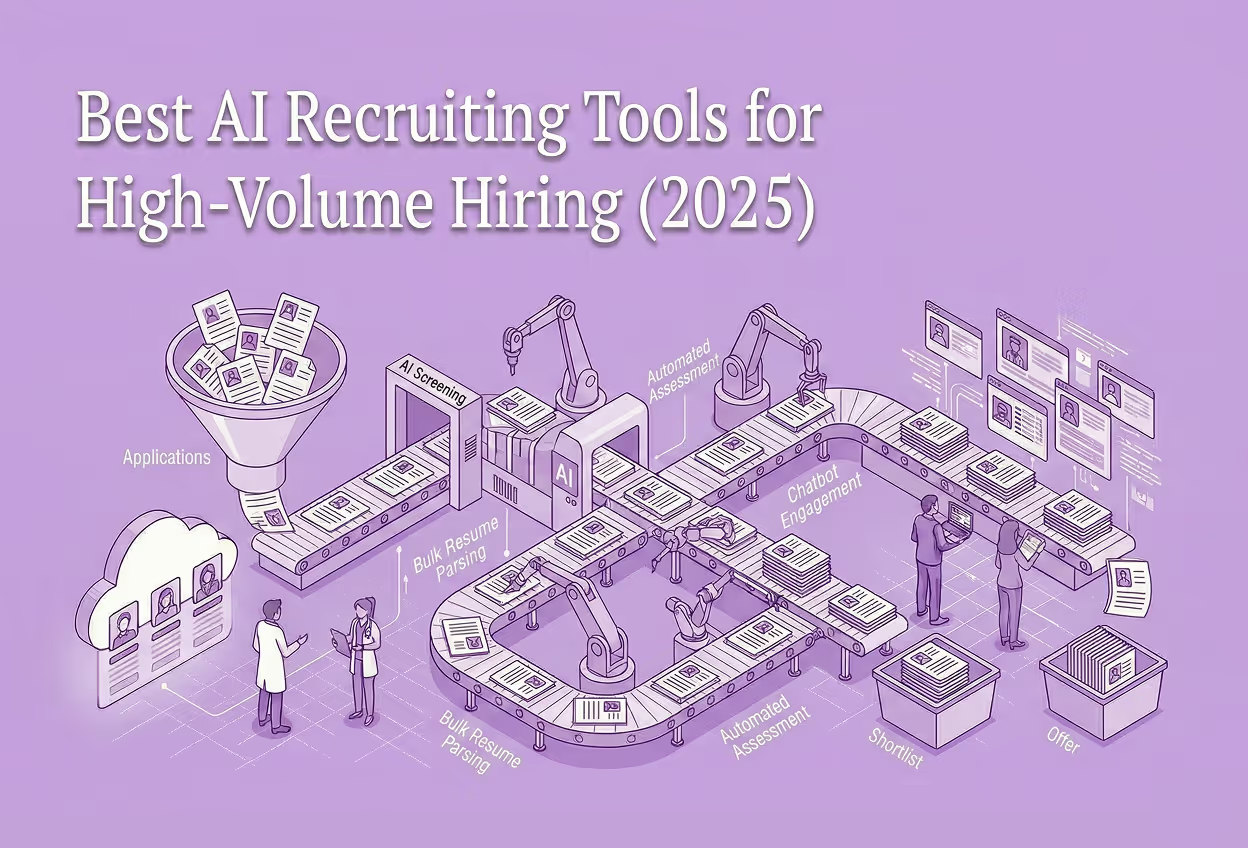
Every tool in this category runs some version of the same pipeline. The parser extracts structured data from resumes — titles, employers, dates, skills. The matcher scores each parsed profile against the job's requirements, from simple keyword overlap to semantic models that treat "customer success manager" and "account manager" as neighbors. The ranker orders candidates and pushes the shortlist into your ATS.
We call this the Screening Depth Ladder, and every product sits on one of three rungs.
- Rung one — keyword filtering. Fast, cheap, and blind to context. Most built-in ATS screeners live here.
- Rung two — semantic matching. Understands synonyms and adjacent skills. This is where the serious standalone tools compete.
- Rung three — structured evaluation. Goes beyond the document to measure the person. Resume screeners cannot reach this rung by definition, which is why the category pairs naturally with interviewing.
The three failure modes
Black-box ranking. The tool outputs a score nobody can explain. When a rejected candidate asks why, or a regulator asks for a bias audit, "the model said so" is not an answer. New York City, Illinois, and Colorado now all require forms of explainability — see our AI hiring laws map.
Credential inheritance. Resume screeners learn from historical hiring data, and historical hiring data encodes historical bias. A model trained on who got hired before will recommend the same schools, employers, and zip codes. The EEOC has said plainly that employers own this outcome.
The confidence illusion. A clean ranked list feels like evaluation. It is not. The resume tells you what someone claims, and screening tells you whether the claims match the posting. Neither tells you whether the person can actually do the work, which is what interviews and assessments exist to measure.
The best AI resume screening software for 2026
| Platform | Best for | Screening depth | ATS fit | Watch out for |
|---|---|---|---|---|
| Eightfold | Enterprise talent intelligence across the full lifecycle | Semantic | Deep native integrations with major HCMs | Enterprise pricing and implementation weight |
| hireEZ | Teams combining sourcing with inbound screening | Semantic | Broad connector library | Stronger on outbound than inbound triage |
| SeekOut | Sourcing-led screening with talent pool analytics | Semantic | Solid ATS sync | Overkill if you only need inbound triage |
| Humanly | Mid-market teams wanting screening plus chat engagement | Semantic plus chat screening | Good mid-market ATS coverage | Lighter analytics than enterprise platforms |
| Zoho Recruit | SMBs already in the Zoho ecosystem | Keyword to semantic | Native inside Zoho | Limited depth outside its own stack |
| Greenhouse built-in | Teams that want triage without a new vendor | Keyword to semantic | Native | Basic compared with standalone tools |
Eightfold — best for enterprise talent intelligence
Eightfold treats resume screening as one surface of a broader talent intelligence platform. Its skills-inference models screen inbound applicants against the same graph it uses for internal mobility and succession, which means screening decisions compound into longer-term workforce data. The tradeoff is weight — this is a platform purchase, not a point tool, and buyers should model the total cost accordingly.
hireEZ and SeekOut — best for sourcing-adjacent screening
Both built their reputations on outbound sourcing and extended into inbound screening. If your team already sources aggressively, screening inbound applicants inside the same workspace removes a swivel-chair step. If you only need to triage inbound volume, you are paying for capability you will not use.
Zoho Recruit and Greenhouse — best built-in options
For teams under roughly 50 open requisitions, the screening already inside your ATS may be enough. The honest test is rung two — if the tool can match semantically and log why it ranked someone, built-in beats a new contract. If it is keyword filtering with a confidence score, it is rung one wearing a suit.
After the resume pile: the evaluation gap
Here is the pattern we see across hundreds of buyer conversations. A team automates resume screening, celebrates the recovered hours, then discovers the bottleneck moved — now they have a shortlist of plausible resumes and no capacity to evaluate them. Recruiters can run perhaps eight real phone screens a day. A shortlist of 200 is a month of calendar.
That is why the strongest 2026 stacks pair document screening with conversational evaluation. Once the pile is triaged, a voice AI interviewer conducts the actual first-round screen — asking follow-up questions, probing claimed experience, and scoring against a rubric. In our testing, Tenzo AI is the editorial pick for this layer, with field-level ATS write-back and auditable rubric scoring that survive both the compliance questions above and a CFO's ROI model. See our voice AI interviewer category guide for the full comparison, or the Tenzo AI review for the deep test.
How to choose
- Confirm which rung of the Screening Depth Ladder you are buying, and make the vendor prove it with your own resumes in a sandbox.
- Demand the audit file — how the model was tested for adverse impact, and what happens when a candidate asks why they were rejected.
- Verify ATS integration depth the way our integration checklist does — write-back into structured fields, not a PDF link.
- Model the full funnel. If screening creates an evaluation backlog, price the interview layer now, not in quarter three. The vendor scorecard weights all of this.
FAQ
What is AI resume screening software?
AI resume screening software parses incoming resumes into structured data, scores each candidate against the job requirements, and ranks them for recruiter review. The best tools use semantic matching that understands related skills and titles, while basic ones rely on keyword overlap. All of them evaluate documents, not people, which is why they pair with interviewing tools.
Is AI resume screening legal?
Yes, with conditions. Employers remain liable for discriminatory outcomes even when a vendor's model produced them, and several jurisdictions now regulate the practice. New York City requires a bias audit for automated employment decision tools, and Illinois, Colorado, and California impose their own duties. Our compliance map covers each state.
Can AI resume screeners reduce bias?
They can reduce some human biases, like fatigue and halo effects, while introducing model biases learned from historical hiring data. The difference between a tool that helps and a tool that hurts is testing — vendors should provide adverse-impact analysis, and employers should re-audit after deployment rather than trusting the pre-sale report.
How much does AI resume screening software cost?
Pricing ranges from bundled ATS features at no extra cost to enterprise contracts in the six figures for talent intelligence platforms. Most standalone screeners price per recruiter seat or per hire. Our AI recruiting software cost guide breaks down the models and the hidden implementation costs that dominate year-one bills.
What is the difference between resume screening and AI interviewing?
Resume screening evaluates documents — what candidates claim on paper. AI interviewing evaluates the person through structured conversation, work samples, or assessments. Screening answers "who is worth talking to," and interviewing answers "who can do the job." Mature funnels use both, with screening first and interviewing before the recruiter call.
How this buyer guide was produced
Buyer guides apply our 100-point evaluation rubric to produce ranked recommendations. Evaluation covers ATS integration depth, structured scoring design, candidate experience, compliance readiness, and implementation quality. No vendor paid to be included or ranked.
Writing a vendor RFP?
The RFP Question Bank covers 52 procurement questions across eight categories — ATS integration, compliance, pricing, implementation, and data ownership.
RFP Question BankAbout the author
Editorial Research Team
Platform Evaluation and Buyer Guides
Practitioners with direct experience in enterprise TA leadership, HR technology procurement, and staffing operations. All buyer guides apply our published 100-point evaluation rubric.
Free Consultation
Get a shortlist built for your ATS and volume
Our research team builds custom shortlists based on your ATS, hiring volume, and specific requirements. No cost, no vendor access to your contact information.
Related Articles
Best Interview Scheduling Software for 2026
The best interview scheduling software for 2026 ranked — GoodTime, Paradox, Calendly, Cronofy, and ModernLoop, plus when scheduling alone is not enough.
Best AI Recruiting Software in 2026
An independent guide to the best AI recruiting software in 2026 — how to read the market, leading platforms by category, and what actually predicts success.
How Much Does AI Recruiting Software Cost in 2026?
An independent 2026 breakdown of AI recruiting software pricing — per-interview costs, the 5 pricing models, hidden fees, and how to build a real 24-month TCO.
How to Switch AI Recruiting Software Without Disrupting Hiring
A phased migration plan for replacing your AI recruiting vendor in 2026 without breaking ATS integrations, scoring continuity, or candidate experience.
Best AI Interviewers for Entry-Level Software Engineer Hiring in 2026
Compare the best AI interviewers for entry-level software engineer hiring in 2026 — HackerRank, CodeSignal, Tenzo AI, Sapia. Pricing, bias methodology, EEOC compliance, and how to screen junior devs and bootcamp grads without pedigree bias.
Best AI Interviewers for Software Engineering Internship Hiring in 2026
Compare the best AI interviewers for software engineering internship hiring in 2026 — HireVue, HackerRank, Tenzo AI, CodeSignal. Campus recruiting workflow, completion rates, and the fall-cycle deployment timeline.